
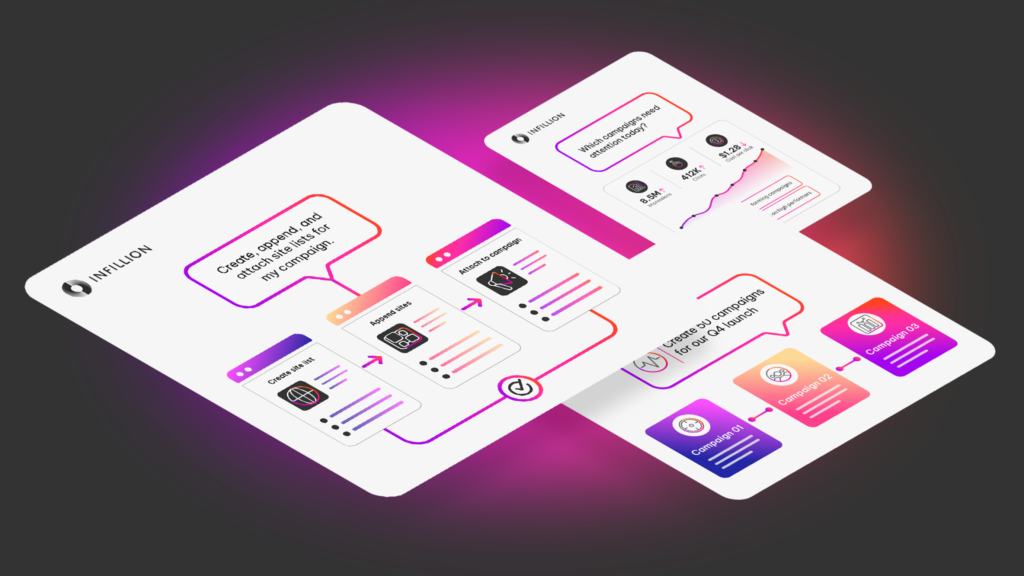
There’s a version of agentic AI being built inside almost every major DSP right now. And there’s a version agencies are building themselves – trained on their own data, encoded with their own business logic. Whether those two things can actually work together, whether an agency’s AI can connect to a platform it didn’t build and execute campaigns through its own intelligence, is a more interesting question than most of the announcements acknowledge.
When we launched the Agent Connector in December, we covered what it was and why we built it. This is what it does in practice.
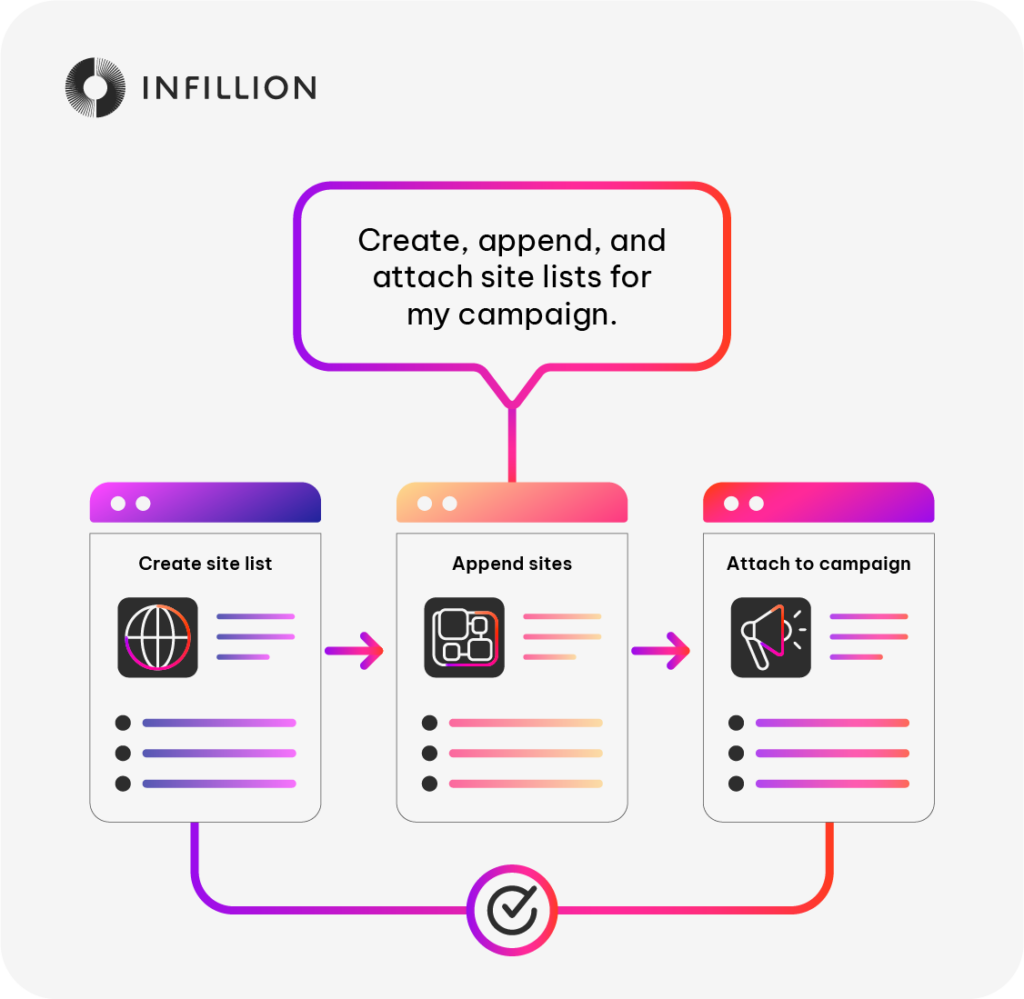
The Infillion Agent Connector lets any compatible AI – ChatGPT, Claude, Gemini, or something your team built – connect to Infillion through an open standard and execute directly: creating and modifying campaigns, pulling and analyzing reporting, managing site lists, and building audiences. The connector is built on Model Context Protocol (MCP), which means any compatible AI connects the same way, with no proprietary integration required. Your AI brings the intelligence, and Infillion handles the execution.
What changes operationally
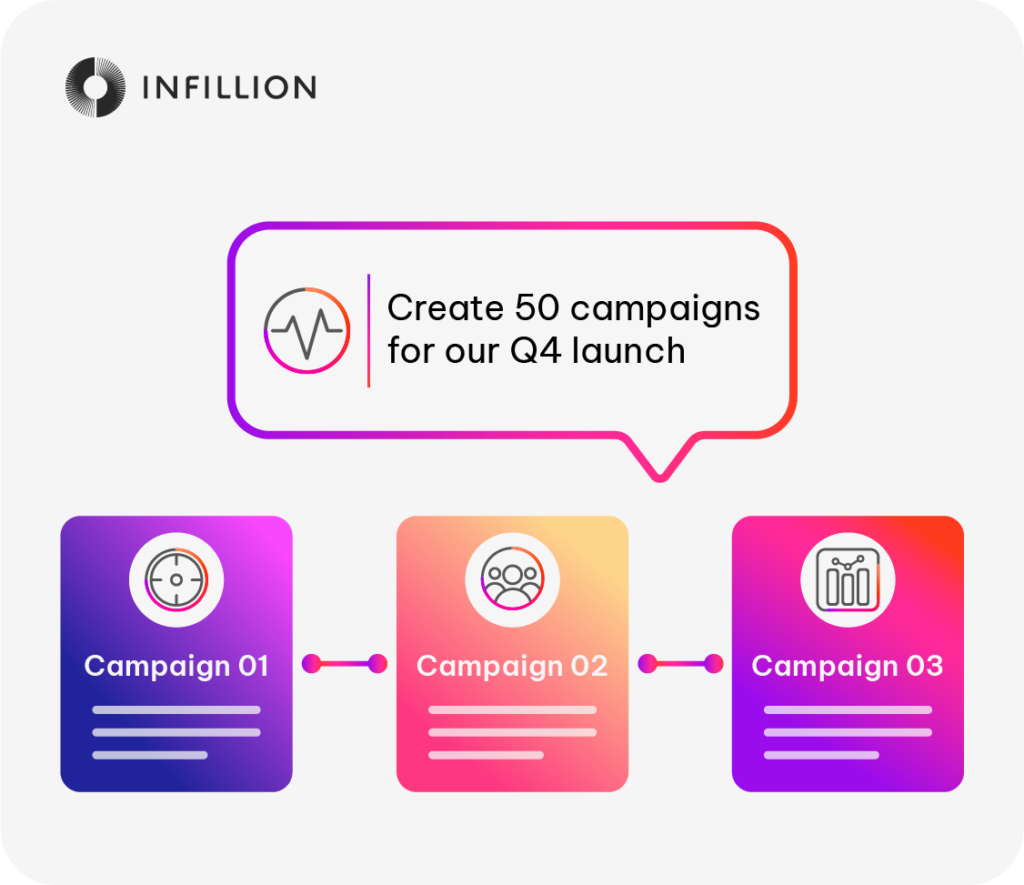
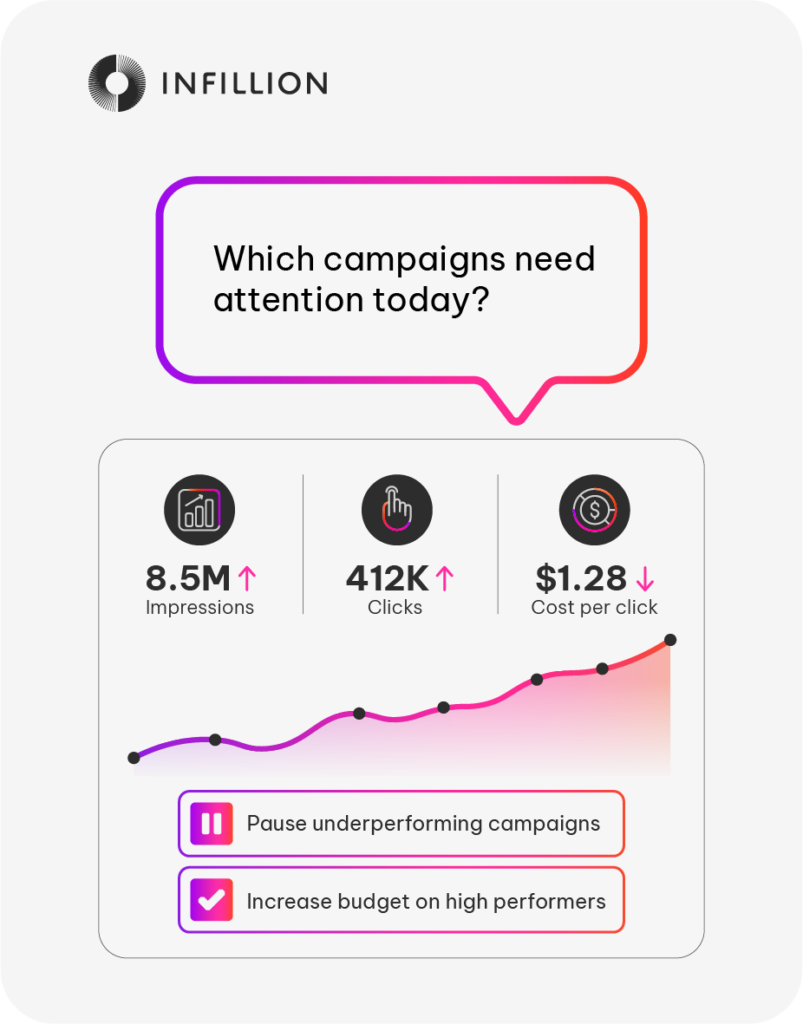
The tasks that consume the most hands-on time in campaign management tend to be the most mechanical: building campaign structures from a brief, pulling domain-level performance data and turning it into exclusion lists, running pacing checks across a large portfolio, and generating reporting in a specific format. With the Agent Connector, these run from a prompt, with the AI handling retrieval, analysis, and execution in sequence.
How it keeps AI costs in check
Most MCP implementations send every available tool for every query – sometimes 100 or more – regardless of what the task actually requires. That overhead lands in the AI’s context window before any real work starts, and at scale the token cost adds up fast. The Agent Connector is designed to keep as much of the heavy lifting on the server as possible and return the smallest number of tokens to the AI. Fewer tokens, lower cost, and that advantage compounds the more you use it.
How control works
Giving an AI permission to act on live campaigns with real client spend attached is not a small thing. The architecture question underneath it – how you maintain visibility into what the AI is doing and why – matters more than most product descriptions let on.
Before any action runs, the AI submits a declared plan – which campaigns it will touch, what it will change, in what sequence. Before execution begins, the Agent Connector checks the plan for common errors and enforces guardrails. Every action is logged afterward with enough context to audit what was intended, what ran, and what changed. If reporting data is incomplete when a write would occur, the system skips that step rather than proceeding on partial information. If a stage fails mid-pipeline, completed work is preserved so the AI can resume rather than restart the entire sequence.
Access is also controlled at the organizational level. By default, the Agent Connector has no visibility into your organization – not campaigns, not strategies, nothing under it. Teams opt in explicitly, and when they do, they set the permission level: read-only for monitoring and reporting, or read and write for execution. These controls are specific to the Connector and apply across your full account hierarchy.
What you need to use it
Any compatible AI connects using the same path, whether that’s a commercial assistant or something your agency built internally.
The Agent Connector is live now across campaign management, reporting, and creatives, with additional capabilities expanding over time.
For more on the technical architecture behind it, check out our Staff Software Engineer John Napiorkowski’s LinkedIn article here.
To see it running against a live platform, request a demo.
