
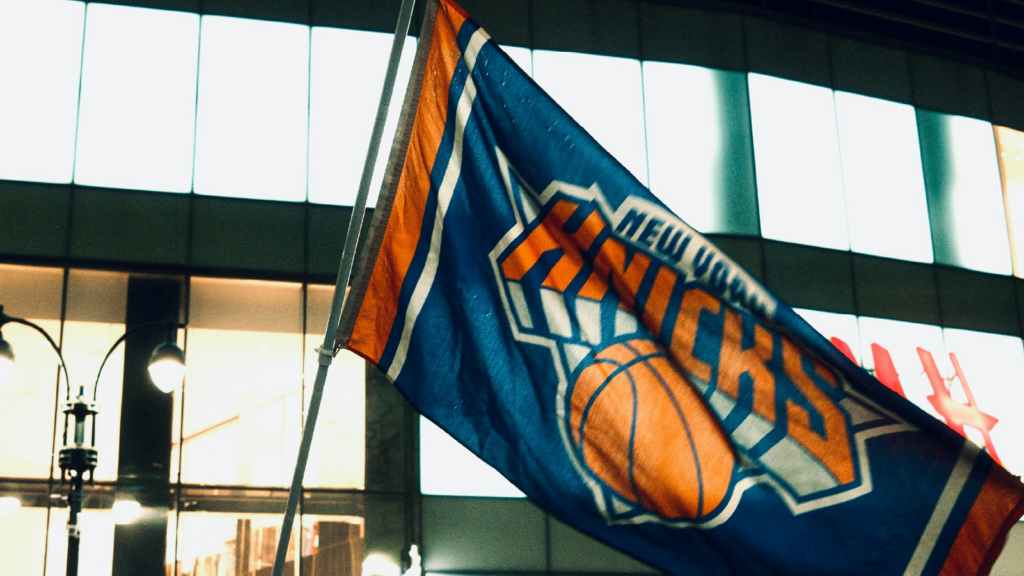
I will finally admit it. I went to bed during halftime of Game 4 of the 2026 NBA Finals. I made the short-sighted decision that scrolling Instagram would be more exciting than watching the Knicks game.
Thankfully, my loved ones were not as defeatist and texted me to “GET UP AND TURN ON THE TV!!” I woke my youngest at 11:15 pm, yelling, “IT’S A ONE-POINT GAME. LET’S GO.”
We sat in our nightgowns through the end of the game, clutching hands and saying little. She is not a huge basketball fan. Neither am I, really. But when you are watching a one-point game in the middle of Brooklyn and your daughter is next to you and the crowd on TV sounds like history in the making, you become a basketball fan.
For Game 5, we wanted to be with the crowd of Knicks fans. We ended up at a bodega with a big screen facing the street, the crowd spilling half a block onto the sidewalk, people watching on phones propped against parked cars. We were not the demographic that most sports media plans get built around. But we were there, locked in, not skipping a second.
That is the audience watching live sports right now. Not just the household that structured its Sundays around the same team for twenty years, but the woman who got a text at 11 pm, the daughter who had never wanted to watch an NBA game, and the crowd outside a bodega that found the game and stayed way past the final buzzer.
Brands are still buying against the first version of that audience. The second version is bigger, less predictable, and watching from places no media plan anticipated.
The audience changed faster than the buying model.
More Fans, More Leagues, More Screens
Infillion’s own research found that 46% of sports fans now watch more sports on streaming than they did before 2020. The NFL has also posted its strongest regular-season viewership in decades, with younger fans contributing to the growth.
The audience has grown, gotten younger, and spread across a league landscape that looks nothing like it did ten years ago. And yet most sports buys are still assembled the same way they always were — one league, one network, one negotiation at a time — for an audience that no longer watches in one place.
The Buy Is Still Catching Up
This is not a secret. In April 2026, AdExchanger ran a piece with the headline: “Programmatic Live Sports Buying Is Starting To Get Less Complicated.” Starting to. The story covered new pacing and frequency tools from DSPs, better supply aggregation from SSPs, and a handful of brands running relatively straightforward campaigns against live events and finding them less technically daunting than expected. Progress, but incremental.
The core challenge has not changed. Live sports rights are still owned by the leagues and distributed across networks, vMVPDs, and regional sports networks. Each one represents a separate negotiation, a separate IO, and a separate data environment. Measurement breaks across the seams. Optimization that works inside one part of the buy does not inform the rest. As a result, most brands access only a fraction of the available sports inventory, concentrate spend on the biggest games they can predict, and leave a significant portion of the audience unreached.
The Game Window Is the Beginning, Not the End
Live sports is a 12-month opportunity. Most brands treat it like three or four.
When you account for the NFL, NBA, NHL, MLB, PGA Tour, ATP Tour, the NCAA, motorsports, and the swiftly growing women’s leagues, there is no true off-season. And beyond the game itself, the shoulder content — pre-game shows, post-game analysis, highlights, sports talk — reaches the full sports audience, not just the viewers who caught the broadcast.
Women’s sports, specifically, represent one of the most compelling inventory positions in digital video right now. Less advertiser clutter, lower CPMs than comparable men’s programming, and engagement running well ahead of expectations. A 3.5x ad impact lift during the 2025 NCAA Women’s Volleyball Championship is not a niche data point. It signals where under-indexed inventory and over-performing audiences intersect.
What a More Connected Buy Looks Like
Infillion’s Infinite Video is built for the version of live sports that exists in 2026, not the one that existed when the standard sports buy was designed.
That means every major league is accessible through a single IO, with no separate negotiations per network or vMVPD. Live-Only for the high-attention game window. Live + Shoulder for the full sports audience beyond it. Direct supply, verified inventory, no unknown paths.
It also means the data follows the fan. For Live Sports campaigns, audience targeting can use Infillion’s proprietary audiences, including Catalina purchase data, first-party location data, and zero-party survey data from streaming viewers. And across Infinite Video, the same identity layer can extend the strategy into OLV and Interactive Video post-broadcast, without rebuilding the audience framework from scratch. Most sports buys lose continuity when the game ends. This one does not.
And it means measurement that closes the loop in one place: brand lift and attention at the top, engagement in the middle, and ROAS and purchase attribution at the bottom. One system, optimizing continuously, not five vendors reconciled after the fact.
The fans who found the game at a bodega will be watching the next one too. On a different screen, at a different time, through a different platform. The brands that can follow them there — and connect that impression back to the one they saw during the game — are the ones that turn a moment into a relationship.
The sports audience does not disappear when the game ends. The media plan should not either.
Ready to rethink your live sports strategy? Get in touch with Infillion to learn how Infinite Video can connect your brand to the full sports audience.
