

For media planners, summer’s the time to plan for the forthcoming holiday season – and for 2025, the outlook hasn’t been clear. Amid inflation and recession fears, are consumers slowing down on spending?
According to our exclusive research in the new Infillion Holiday 2025 Playbook, it’s clear that while holiday shopping isn’t slowing down, consumers are getting a lot more strategic. They’re rethinking their priorities and placing a higher premium on relevance, trust, and impact. When it comes to spending, a new divide is emerging: We see that 22% of shoppers aged 35–54 plan to spend more than $1,000, while the $250–$500 bracket is also growing. In contrast, both the $100–$250 and $500–$1,000 ranges are shrinking – a clear sign that the middle is thinning out.
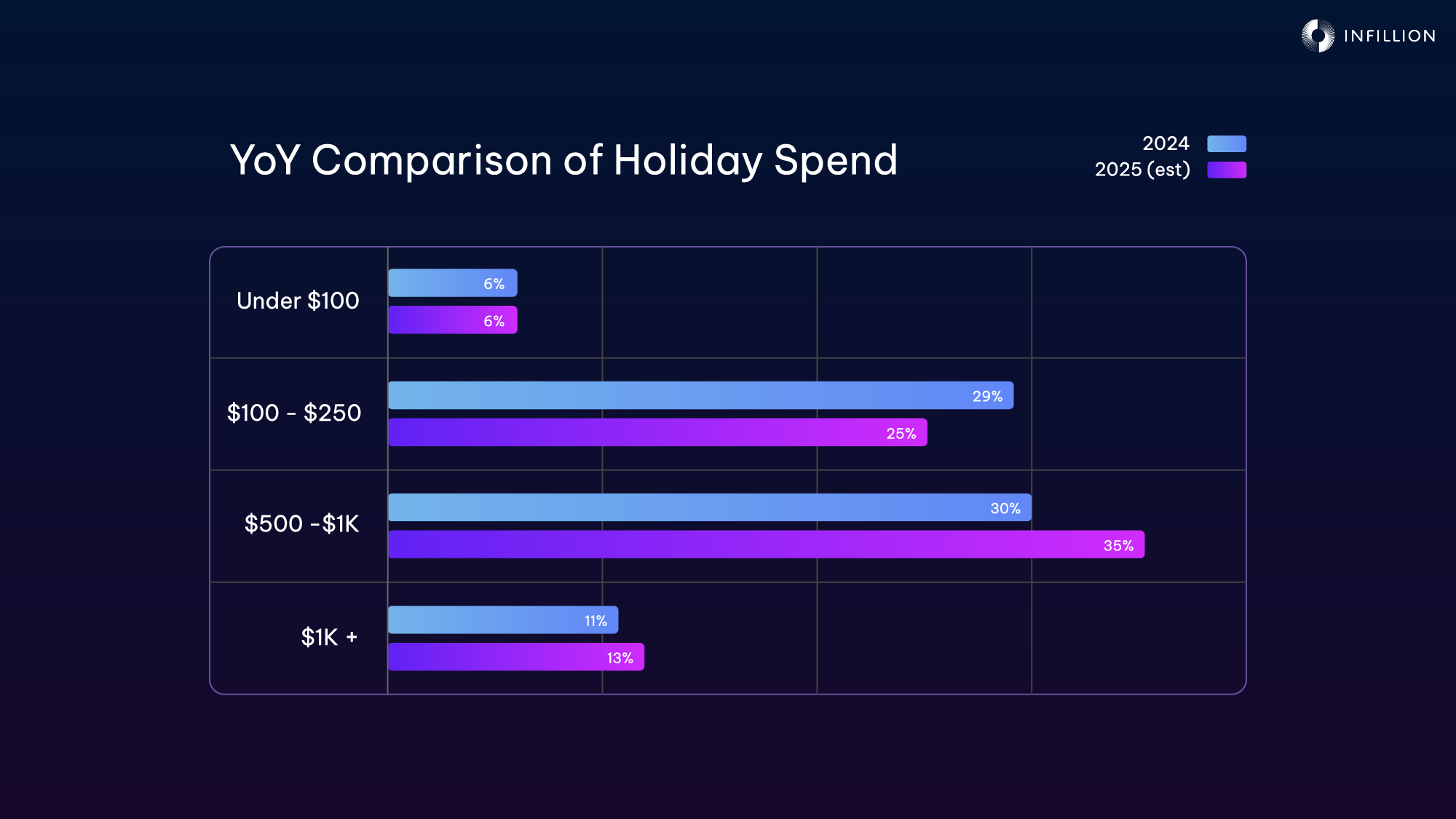
These trends follow a 2024 holiday season that was record-setting, but nuanced. U.S. online sales during Black Friday and Cyber Monday reached $24.1 billion, marking a 3.4% year-over-year increase, while 81.7 million shoppers showed up in physical stores. On the other hand, while top-line numbers looked strong, shopper behavior beneath the surface began to shift: The divide in physical vs. digital shopping varied by demographic, intent was fragmented by income, and shopping windows tightened. In 2025, that fragmentation is accelerating.
Two Holiday Shoppers, Two Mindsets
Brands must now speak to two very different consumer mindsets – the deal-driven shopper looking for reassurance and efficiency, and the high-intent spender seeking quality, confidence, and impact. This bifurcation creates both a challenge and an opportunity. To reach both, marketers will need sharper segmentation, earlier messaging, and creative that delivers clear, timely value.
Segmentation in 2025 doesn’t stop at spending tiers – it extends to how different audiences shop. According to the Infillion Holiday 2025 Playbook, 76% of men plan to shop online, compared to just 61% of women. Income plays a role too: Lower-income shoppers are more likely to prefer in-store, while higher-income audiences skew digital-first. Surprisingly, middle-income shoppers are the least likely to shop fully online, forming a U-shaped trend in digital adoption, where both low- and high-income groups shop more online than the middle-income segment.
Age matters as well. While only 12% of older shoppers do their holiday shopping entirely online, younger audiences expect seamless transitions across channels – often starting with mobile research and finishing in-store (or vice versa).
 From Budgeting to Behavior: The Rise of Value Vigilance
A value-first holiday strategy doesn’t just tailor messaging by budget – it adjusts channel, format, and frequency based on real behavioral patterns. Whether it’s deploying dynamic digital creative for high-income shoppers, or emphasizing availability and convenience for in-store buyers, matching the message to the mindset is everything.
This mindset shows up as value vigilance – a careful, deliberate approach to spending where every dollar has to do more. Price still matters, but shoppers are also looking for confidence that they’re making the right decision, getting the most for their money, and not wasting time. That means fewer impulse buys, more research, and higher expectations around clarity, quality, and ease. A $40 blanket might get purchased if it feels personal. A $400 tech item might not – unless the shopper feels sure that it delivers both value and impact.
Turning Insight Into Action
For marketers, value vigilance reshapes more than messaging – it changes the mechanics of the customer journey. When shoppers are scrutinizing every dollar and every moment, brands need tools that eliminate friction, reward attention, and close the gap between intent and action. Infillion helps marketers meet these moments with formats and strategies built for this new level of shopper precision.
From Budgeting to Behavior: The Rise of Value Vigilance
A value-first holiday strategy doesn’t just tailor messaging by budget – it adjusts channel, format, and frequency based on real behavioral patterns. Whether it’s deploying dynamic digital creative for high-income shoppers, or emphasizing availability and convenience for in-store buyers, matching the message to the mindset is everything.
This mindset shows up as value vigilance – a careful, deliberate approach to spending where every dollar has to do more. Price still matters, but shoppers are also looking for confidence that they’re making the right decision, getting the most for their money, and not wasting time. That means fewer impulse buys, more research, and higher expectations around clarity, quality, and ease. A $40 blanket might get purchased if it feels personal. A $400 tech item might not – unless the shopper feels sure that it delivers both value and impact.
Turning Insight Into Action
For marketers, value vigilance reshapes more than messaging – it changes the mechanics of the customer journey. When shoppers are scrutinizing every dollar and every moment, brands need tools that eliminate friction, reward attention, and close the gap between intent and action. Infillion helps marketers meet these moments with formats and strategies built for this new level of shopper precision.- TrueX delivers opt-in engagement, ensuring that your message connects with high-intent shoppers. When audiences choose to engage, you get guaranteed attention and an opportunity to educate.
- NeXt mobile retargeting closes the loop, reaching previously exposed users when urgency is highest. Retarget with countdown displays, inventory updates, or shipping reminders to nudge consideration into conversion.
- ShopX enables click-to-cart functionality within the ad itself, removing friction while encouraging decisive action. Think gift guides that turn into shopping carts, or real-time promotions that show updated pricing.
Case in Point: ShopX in Action
One Infillion holiday campaign using ShopX generated significant direct-to-cart transfers, with an average 3.3% click-through rate – more than double the industry benchmark. The impact extended beyond commerce: A brand study conducted with our UpLift measurement technology showed a +27% lift in purchase intent and a +25% lift in brand familiarity. For value-vigilant shoppers, that kind of seamless, high-utility experience builds trust – and drives action.
Turn Value Vigilance into a Smart Holiday Strategy
When it comes to holiday gifting, shoppers are weighing their choices more carefully than ever. That means that in this year’s high-stakes holiday landscape, every impression has to work harder. Consumers are scanning for relevance, speed, and substance, and they’re tuned into more than just price tags. They want value that’s clear, creative, and timely from the first impression to the final click. For marketers, this shift demands sharper planning and messaging that’s both emotionally resonant and tactically precise.
- Start early: 15% of holiday shoppers begin browsing in October. With intent dropping sharply by December, brands that wait to advertise until Cyber Week risk being left behind.
- Segment by intent: High spenders want confidence and craftsmanship; mid-tier buyers want practicality and purpose. Mirror their motivations in your messaging.
- Use scarcity wisely: Countdown displays, inventory updates, and last-ship alerts work best when they’re real, relevant, and respectful of the shopper’s time.
Today’s value-focused consumers aren’t impulse-driven, they’re intentional. When brands align creative, timing, and utility, they do more than drive conversions – they build trust. You don’t solely win on price anymore. Rather, you win by being the most useful, timely, and easiest for consumers to act on.
In 2025, helpfulness is impact. When every dollar matters, every impression should count. With the right mix of strategy, sizzle, and storytelling, your holiday campaigns will deliver standout results – no matter the budget.
Want to find out more about how these holiday strategies could look like for your brand? Get in touch to make this holiday season your most impactful yet.
