
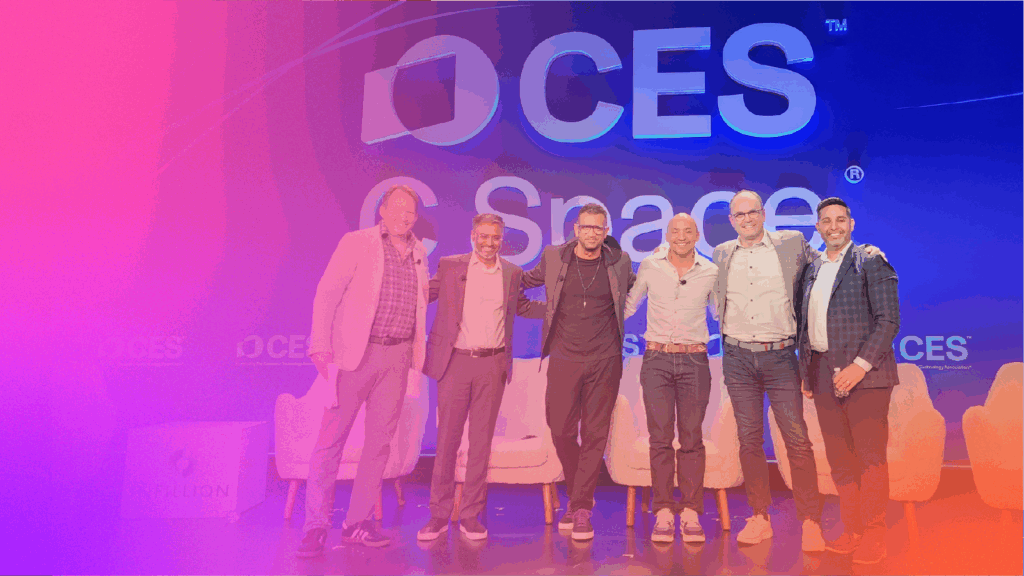
At CES 2026, conversations about AI in advertising felt different.
Not louder. Not more speculative. More resolved.
The industry has moved past asking whether AI belongs in media workflows. The real question now is what kind of infrastructure can actually support autonomous execution at scale—without sacrificing control, economics, or trust.
That question is exactly why Infillion hosted Grab the Rocketship: How Agentic AI Rewrites the $1.1T Media Business, a panel that brought together leaders across media, data, and platform infrastructure. The goal wasn’t to predict the future. It was to pressure-test what’s already becoming true.
What emerged was a clear validation of the foundation Infillion has been building toward: open, composable, agentic-ready advertising infrastructure.
Moderator: Jeremy Woodlee, GM of Enterprise, Infillion
Panelists:
- Mansoor Basha, CTO, Stagwell Marketing Cloud
- Frederico Salivitti, Chief Growth Officer, Mint
- John Hoctor, CEO & Co-founder, Newton Research
- Marcos Escalante, Chief Product Officer, Infillion
Agentic AI Changes Where Value Lives
For years, innovation in ad tech has focused on tools: smarter dashboards, faster optimizations, and more automated features layered onto existing systems. But agentic AI breaks that model.
Autonomous systems don’t need interfaces designed for humans. They need infrastructure designed for decisioning—clean inputs, transparent feedback loops, and execution layers that don’t introduce friction or opacity.
This is where the industry is now converging: value is moving below the interface, into the architecture itself.
As Infillion’s Marcos Escalante, Chief Product Officer at Infillion, noted during the panel, once backend capabilities become widely available, differentiation comes down to experience and efficiency:
“Once the backend tech becomes a commodity, the brand that wins is the one that removes the most friction. If your foundation makes the user’s life harder, the math just won’t work.”
This is precisely why Infillion operates as a composable platform rather than a monolithic stack. When components across data, demand, supply, and creative can be orchestrated—rather than siloed—execution becomes faster, clearer, and more adaptable over time.
Autonomy Turns Scale Into an Economic Question
One of the strongest signals from the conversation was that scaling AI is no longer primarily a technical challenge. It’s an economic one.
As compute costs rise and autonomous workloads increase, infrastructure decisions directly determine whether AI-driven execution is sustainable—or simply impressive in the short term.
Mansoor Basha, CTO of Stagwell Marketing Cloud, framed the issue succinctly:
“If your compute costs are growing faster than the value you’re delivering, you don’t have a business—you have a science project.”
This reality is already reshaping the market. Growth without durability is no longer rewarded. Platforms that can’t scale efficiently under agentic execution will struggle, regardless of how advanced their AI appears.
Infillion’s approach—decoupling intelligence from infrastructure and enabling orchestration across interoperable components—addresses this head-on. When execution is designed to minimize waste and unnecessary hops, performance gains compound rather than erode margins.
Trust and Transparency Are Architectural Decisions
As execution becomes autonomous, trust can no longer be treated as a policy layer added after the fact. It must be embedded into the system itself.
John Hoctor, CEO and Co-founder of Newton Research, emphasized that transparency starts at the foundation:
“Data privacy shouldn’t be something you think about at the end. It has to be the first line of code you write.”
In an environment shaped by heightened consumer awareness, regulatory scrutiny, and AI opacity, platforms that can’t explain decisions won’t scale. Infrastructure that treats data and intelligence as utilities—rather than black boxes—creates the conditions for trust at scale.
This principle is core to Infillion’s platform design. Clients retain ownership of their data, intelligence, and execution, whether they engage through managed service, self-service, hybrid workflows, or agentic execution. Control doesn’t disappear as automation increases—it becomes more important.
Leadership in the Agentic Era
The panel also underscored a broader shift in leadership responsibility. As AI moves from assisting work to operating it, the stakes increase—not just technically, but ethically.
Federico Salvitti, Chief Growth Officer at Mint, captured this clearly:
“Responsibility is the flip side of innovation. If we don’t lead with an ethical framework, regulators will set the pace for us—and that’s rarely the best environment for innovation.”
Autonomy doesn’t remove human accountability. It heightens it. The platforms that succeed will be the ones that make governance, guardrails, and explainability part of execution—not obstacles to it.
Jeremy Woodlee, GM of Enterprise at Infillion, closed the session by distilling the discussion into a practical mandate for leaders:
“Build the foundation now, watch the economics, remove friction, lead with trust, and set clear boundaries.”
Why Infillion Built for This Moment
Infillion convened this conversation because the industry is entering a phase where infrastructure choices matter more than feature roadmaps.
The Infillion Platform unifies industry-leading components across the advertising supply chain into a single, open, composable system—designed for orchestration and agentic execution. When these components are activated together, they unlock multiplicative value: greater efficiency, faster adaptation, and better outcomes over time.
This belief is embodied in the Infillion Agent Connector, announced at CES, which allows AI agents—Infillion’s or a client’s—to connect directly into the platform to plan, optimize, and execute media with transparency and control.
This isn’t about retrofitting AI onto legacy systems. It’s about building a foundation that autonomy can actually run on.
The Real Takeaway
The most important insight from Grab the Rocketship wasn’t about models, copilots, or automation tactics.
It was about direction.
The teams that win in the agentic era won’t be the ones chasing the newest AI breakthrough. They’ll be the ones who choose open, composable, agent-native infrastructure—systems that scale economically, operate transparently, and adapt as business needs change.
Because when AI runs media, the question isn’t if it will execute.
It’s where, how, and on whose terms.
See Agentic Execution in Action
The Infillion Agent Connector demo is now live. If you want to see what agent-native media execution looks like in practice, you can explore the demo and connect with the Infillion team.
